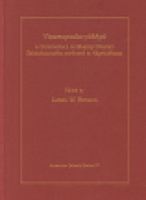




Viṣamapadavyākhyā
A Commentary on Bhaṭṭoji Dīkṣita's Śabdakaustubha Attributed to Nāgeśabhaṭṭa
James Benson
Viṣamapadavyākhyā
A Commentary on Bhaṭṭoji Dīkṣita's Śabdakaustubha Attributed to Nāgeśabhaṭṭa
James Benson
The study of Sanskrit grammar is widely recognized as one of India’s great intellectual traditions. The most famous school of grammar was the one based on Pāṇini’s Aṣṭādhyāyī, a work dating from perhaps the fifth or fourth century BC and consisting of approximately four thousand short rules arranged in eight books. Over two millennia scholars produced a huge literature of commentaries to explain how these rules work. Alternative schools were also developed, either to provide easier access to the classical language or to create authoritative texts for groups with distinct religious or social identities.
- Description
- Table of Contents
- Subjects
A considerable amount of scholarship was produced by the Pāṇinian school between the sixteenth and eighteenth centuries. Two of the most famous scholars from this period were Bhaṭṭoji Dīkṣita and Nāgeśabhaṭṭa. The former composed the hugely influential Siddhāntakaumudī, a commentary on the Aṣṭādhyāyī in which Pāṇini’s rules were radically reordered. Before composing this work, Bhaṭṭoji wrote the Śabdakaustubha commentary on the unaltered text of the Aṣṭādhyāyī. This was a massive work that was perhaps never completed. In his other grammatical works Bhaṭṭoji refers readers to the Śabdakaustubha for further details. Nāgeśabhaṭṭa was a pupil of Bhaṭṭoji’s grandson and is often regarded as the last great figure in the tradition of grammatical scholarship. He wrote several authoritative books on grammar, including three celebrated commentaries on Bhaṭṭoji’s works.
The existence of the Viṣamapadavyākhyā, a commentary on the important first nine lessons (āhnikas) of the Śabdakaustubha, was made known by cataloguers of Sanskrit manuscripts in the nineteenth century. The work was attributed to Nāgeśabhaṭṭa, but the question of authorship was never investigated. The present book is the first published edition of the text, and is based on nineteen manuscripts. These preserve widely differing versions that may possibly reflect the author’s own revisions. In the Introduction, the question of authorship is discussed. This cannot yet be answered definitively, but it seems quite possible that Nāgeśabhaṭṭa could have written the work. Although portions of two other commentaries directed to the first nine lessons of the Śabdakaustubha have recently been published, these portions cover a relatively small amount of the text. The present work is the first to offer a complete commentary.
Acknowledgments
Introduction
The Śabdakaustubha and Its Commentaries
The Identification of the Viṣamapadavyākhyā
Authorship of the Viṣamapadavyākhyā
Introductory and Concluding Verses in the Manuscripts
The Viṣamapadavyākhyā and Nāgeśa’s Other Works
The Viṣamapadavyākhyā and the Śabdakaustubha
Manuscripts of the Viṣamapadavyākhyā
Remarks on the Individual Manuscripts
References to śodhapatras, pāṭhāntaras, etc. in the Manuscripts
Relationship of the Manuscripts
Editorial Principles
Use of Vaidyanātha’s Prabhā for Editing the Viṣamapadavyākhyā
The Text of Vaidyanātha’s Prabhā
Textual References, Abbreviations, and Conventions
Page Index to the Viṣamapadavyākhyā and the Śabdakaustubha
Text of the Viṣamapadavyākhyā
Āhnika 1
Āhnika 2
Āhnika 3
Āhnika 4
Āhnika 5
Āhnika 6
Āhnika 7
Āhnika 8
Āhnika 9
Appendices
A: Manuscripts of the Viṣamapadavyākhyā not used in the edition
B: Folio index for the Viṣamapadavyākhyā manuscripts
C: Introductory salutations and intermediate colophons
D: Prabhā passages not given in the notes to the text
E: References to Nārāyaṇa, Ratnakṛt, Vivaraṇakṛt, and Sīradeva
Bibliography
Indices
Mailing List
Subscribe to our mailing list and be notified about new titles, journals and catalogs.