


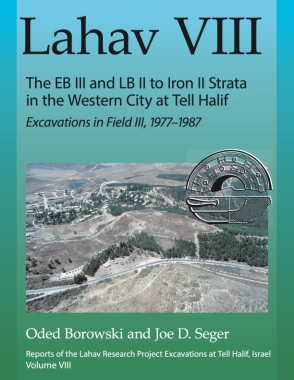
Lahav VIII: The EB III and LB II to Iron II Strata in the Western City at Tell Halif
Excavations in Field III, 1977–1987
Oded Borowski and Joe D. Seger
Lahav VIII: The EB III and LB II to Iron II Strata in the Western City at Tell Halif
Excavations in Field III, 1977–1987
Oded Borowski and Joe D. Seger
“While broad archaeological conclusions are important in a final report, they also become dated quickly. To present a detailed and argued stratigraphic matrix along with descriptions of what was found in most of the archaeological contexts, is the key to a successful final archaeological report that will withstand years of scholarship. What was found, where was it found, what was found with it, and in what context are the data that future researchers will seek. Borowski and Seger have provided just that.”
- Description
- Reviews
- Bio
- Table of Contents
Excavations in Field III revealed the development of Tell Halif’s western defenses from the Early Bronze period onward, culminating in a substantial Iron Age II fortification line. This stratum includes casemate-like pillared houses fronted by a sloping stone-faced glacis, forming the city’s western fortification system. Four successive Iron Age II occupation phases document the evolution of domestic architecture and material culture from the ninth through early seventh centuries BCE, providing key evidence for patterns of household organization, daily life, and urban planning in the late Iron Age.
Together with complementary data published from other excavation areas at Tell Halif, the Field III materials offer an essential dataset for the study of Judahite settlement and fortification systems. This volume contributes significantly to scholarship on the social and architectural development of Iron Age towns in the southern Levant and to ongoing discussions of the historical and archaeological contexts of the late eighth-century BCE Assyrian campaigns in Judah.
“While broad archaeological conclusions are important in a final report, they also become dated quickly. To present a detailed and argued stratigraphic matrix along with descriptions of what was found in most of the archaeological contexts, is the key to a successful final archaeological report that will withstand years of scholarship. What was found, where was it found, what was found with it, and in what context are the data that future researchers will seek. Borowski and Seger have provided just that.”
Oded Borowski is Professor Emeritus of Biblical Archaeology and Hebrew at Emory University. He directed Phase IV of the excavations at Tell Halif between 2005 and 2016, and is the author of Lahav III.
Joe D. Seger is Professor Emeritus of Religion and Director Emeritus of the Cobb Institute of Archaeology at Mississippi State University. He organized the Lahav Research Project and directed Phases I, II, and III of the excavations at Tell Halif between 1976 and 1993, and is coauthor of Lahav V, Lahav VI, and Lahav VII.
List of Figures
List of Photographs
List of Tables
Series Editor’s Preface
Authors’ Preface
Chapter 1 General Introduction
Chapter 2 Cultural Historical Summary
1. The Geographical Setting
2. Identification of the Site
3. The Bronze Ages at Halif
4. The LB IIB/Iron I Transition
5. The Iron II Settlement in Field III
6. Resettlement at Halif After Iron II
7. Daily Life at Iron Age II Halif
Excursus: Textile Production at Tell Halif
Chapter 3 Stratigraphy
1. A Brief History of Occupation
2. The Early Bronze Age (Strata XV–XIV)
2.1. Stratum XV
2.2. Stratum XIV
3. The Late Bronze Age (Stratum VIII)
3.1. Stratum VIIIB
3.2. Stratum VIIIA2
3.3. Stratum VIIIA1
4. The Iron Age I (Stratum VII)
4.1. Stratum VIIC
4.2. Stratum VIIB
4.3. Stratum VIIA2
4.4. Stratum VIIA1
5. The Iron Age II (Strata VIC–VIA)
5.1. Stratum VIC
5.2. Stratum VIB
5.3. Stratum VIA
6. Persian and Roman/Byzantine Strata V and III
6.1. Persian Traces (Stratum V)
6.2. Late Roman/Byzantine Traces (Stratum III)
6.3. Strata V and III Summary
vi Table of Contents
Chapter 4 Selected Objects
1. Introduction
2. Personal Adornment Objects
2.1. Cosmetic Palette
2.2. Ivory Comb
2.3. Rings
2.4. Cosmetic Applicators
2.5. Beads
2.6. Fibulae and Pins
3. Weapons
3.1. Arrowheads
3.2. Lance Head
3.3. Sling Stones (Ballistae)
3.4. Mace Head
4. Figurines
4.1. Female Chair Figurine
4.2. Animal Head
4.3. Figurine Mold
5. Metal Implements
5.1. Sickle
5.2. Nails
6. Bone Artifacts
6.1. Game Pieces (Astragali)
6.2. Spatulae
7. Stone Artifacts
7.1. Flint Tools
7.2. Grindstones
7.3. Weight Stones
7.4. Scale Weights
7.5. Mortars and Vats
7.6. Palette
7.7. Pestle or Drill Cap
8. Inscribed Objects
8.1. Ostracon
8.2. Inscribed Pottery
9. Spinning and Weaving Implements
9.1. Clay Loom Weights
9.2. Spindle Whorls
Chapter 5 Summary and Conclusions
1. Summary
2. Conclusions
References
Also of Interest
Mailing List
Subscribe to our mailing list and be notified about new titles, journals and catalogs.