




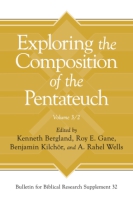
Exploring the Composition of the Pentateuch, Volume 3/1
Edited by Kenneth Bergland, Roy Gane, Benjamin Kilchör, and A. Rahel Wells
Exploring the Composition of the Pentateuch, Volume 3/1
Edited by Kenneth Bergland, Roy Gane, Benjamin Kilchör, and A. Rahel Wells
“This volume explores different avenues for interpreting the Pentateuch and investigating its composition history. The whole project is a valuable contribution to the field; several chapters are of such great importance that they alone make this an essential resource. Among these are the study of the linguistic dating of texts by Bergland and the discussion of intertextuality by Bergland and Masotti.”
- Description
- Reviews
- Bio
- Table of Contents
- Sample Chapters
Emphasizing the need to move beyond critique toward positive proposals supported by verifiable data and sound argumentation, the essays in this volume are organized into three areas of inquiry. Part 1 examines whether the Torah can be understood as a unified literary work in the form in which it has come down to us, probing inner-biblical relationships, the unity of Genesis narratives, and the Decalogic shape of Deuteronomic law. Part 2 considers historical and archaeological evidence for the Pentateuch’s setting, including artifact analysis, wilderness sanctuary materials, and linguistic forensics. Part 3 investigates issues such as Egyptian loanwords, early Hebrew linguistic features, diachronic development, and textual variants.
While this volume is forward-looking, it does not pretend to present a unified or finalized model. Instead, it offers a foundational step toward an evidence-based and methodologically transparent approach to Pentateuchal studies. It will be of particular interest to scholars and advanced students of biblical studies, the Hebrew Bible, and the history of the Pentateuch’s composition.
In addition to the editors, the contributors include Richard E. Averbeck, L. S. Baker Jr., Yoel Elitzur, Georg Fischer, Yehoshua Inbal, Richard S. Hess, Michael LeFebvre, Benjamin Noonan, and Gary Rendsburg.
“This volume explores different avenues for interpreting the Pentateuch and investigating its composition history. The whole project is a valuable contribution to the field; several chapters are of such great importance that they alone make this an essential resource. Among these are the study of the linguistic dating of texts by Bergland and the discussion of intertextuality by Bergland and Masotti.”
“A rich and thought-provoking collection of essays that moves Pentateuchal research beyond older source-critical paradigms toward a more text-centered and compositionally nuanced approach. The contributors interact deeply with current scholarship while advancing genuinely constructive new proposals.”
Kenneth Bergland is Assistant Professor at the Adventist International Institute of Advanced Studies, Philippines.
Roy E. Gane is Professor of Hebrew Bible and Ancient Near Eastern Languages at Andrews University.
Benjamin Kilchör is Professor of Old Testament at STH Basel.
A. Rahel Wells is Professor of Hebrew Bible at Andrews University.
List of Tables
Preface
List of Abbreviations
INTRODUCTION
Kenneth Bergland, Roy E. Gane, Benjamin Kilchör, and A. Rahel Wells
PART 1: CAN THE TORAH BE READ?
CHAPTER 1. Literary Dependence in the Pentateuch: Three Theses Toward a New Model for Pentateuchal Composition
Benjamin Kilchör
CHAPTER 2. Genesis 1–2 as “Reading Instruction”
Georg Fischer
CHAPTER 3. The Composition of Genesis 1–11 in Light of Genesis 12–50 and Related Ancient Near Eastern Texts
Richard E. Averbeck
CHAPTER 4. The Literary Unity of the Abraham Narrative
Gary A. Rendsburg
CHAPTER 5. The Decalogical Shape of the Deuteronomic Law Collection
Michael LeFebvre
PART 2: HISTORICAL AND ARCHAEOLOGICAL STUDIES
CHAPTER 6. Wilderness Sanctuary Materials: Can Content Reveal Composition Timing
L. S. Baker Jr.
CHAPTER 7. New Discoveries and Archaeological Studies in Pre- and Early Israelite Religion of the Second Millennium
Richard S. Hess
PART 3: LINGUISTICS AND TEXTUAL CRITICISM
CHAPTER 8. Diachronic Linguistics and the Composition of the Pentateuch
Kenneth Bergland
CHAPTER 9. Seven Biblical Hebrew Words and Phrases That Only Occur After the Composition of the Pentateuch
Yehoshua Inbal and Yoel Elitzur
CHAPTER 10. The Egyptian Loanwords in the Exodus and Wilderness Traditions: Stylistic Literary Devices or Authentic Historical Artifacts?
Benjamin J. Noonan
CHAPTER 11. Implications of Textual Variants Concerning the Israelite Cult in the Samaritan Pentateuch for the Development of the Pentateuch
Roy E. Gane
Ancient Source Index
Subject Index
Download a PDF sample chapter here: Introduction
Also of Interest
Mailing List
Subscribe to our mailing list and be notified about new titles, journals and catalogs.