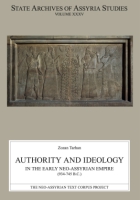



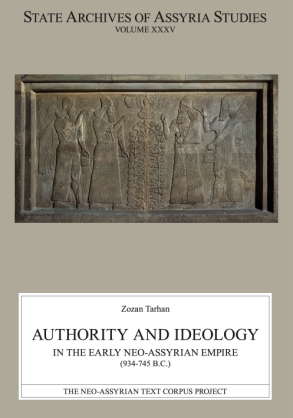
Authority and Ideology in the Early Neo-Assyrian Empire (934–745 B.C.)
Zozan Tarhan
This monograph explores royal authority and ideology in the early Neo-Assyrian Empire (934–745 B.C.). It comprises four parts: (I) an overview of the sources, (II) a historical introduction to Assyria prior to the Neo-Assyrian period, and the two main sections devoted to analyzing (III) authority and (IV) ideology. Part III focuses on the reigns of the ten Assyrian kings of this period and studies their military, political, and building activities. This section discussed issues of authority in the context of military and political events, including Assyrian expansion, military campaigns, and building projects, as well as clarifying uncertain dating and chronology of events. Part IV studies the ideological framework of the actions of the Assyrian kings—that is, the justifications and motivations for their deeds—by analyzing the ideological motifs, beliefs, and messages of textual and visual narratives. Tarhan investigates Assyrian royal ideology from multiple angles, considering its religious nature, the imperial mission, and the portrayal and different roles of the Assyrian king.
- Description
- Bio
- Table of Contents
- Sample Chapters
- Subjects
The methodology combines philological work with cuneiform texts, analyses of iconographic sources, and archaeological data. The book aims to provide a comprehensive historical and cultural analysis of the reigns of the Assyrian rulers and the ideology of kingship. It tackles a desideratum of Assyriology and contributes to ancient Near Eastern studies and ancient history in general by tracing the constants and variations in Assyrian royal ideology.
Zozan Tarhan is an Assyriologist whose research interests are primarily focused on the Neo-Assyrian Empire, Assyrian royal ideology, and Mesopotamian scholarship. She has published one monograph and several articles dealing with these topics.
PREFACE AND ACKNOWLEDGEMENTS
ABBREVIATIONS
LIST OF FIGURES
INTRODUCTION
I. SOURCES
I.1. Textual Sources
Royal Inscriptions
Limmu Lists
Chronicles
King Lists
Ritual and Cultic Texts
Literary Sources
Other Sources
I.2. Archaeological and Iconographic Sources
II. HISTORICAL EXPOSÉ OF ASSYRIA BEFORE THE NEOASSYRIAN
PERIOD: SOME REMARKS ON THE DEVELOPMENT
OF ROYAL AUTHORITY AND IDEOLOGY
II.1. Assyria in the Old Assyrian Period (ca. 2004-1736 B.C.)
II.2. Assyria in the Middle Assyrian Period (1353-935 B.C.)
III. AUTHORITY IN THE EARLY NEO-ASSYRIAN EMPIRE
III.1. Aššur-dān II (934-912 B.C.)
Military Campaign in the West/Northwest
Military Campaigns in the North/Northeast
Military Campaign in an Undeterminable Direction
Building Activities and Renovations
Summary and Concluding Remarks
III.2. Adad-nērārī II (911-891 B.C.)
Military Campaigns
Building Activity
Summary and Concluding Remarks
III.3. Tukultī-Ninurta II (890-884 B.C.)
Military Campaigns
Building Activity
Summary and Concluding Remarks
III.4. Ashurnasirpal II (883-859 B.C.)
Foreign Policy: Military Campaigns
Internal Affairs and Building Activity
Summary and Concluding Remarks
III.5. Shalmaneser III (858-824 B.C.)
Foreign Policy: Military Campaigns
The Rebellion
Building Activity
Summary and Concluding Remarks
III.6. Šamšī-Adad V (823-811 B.C.)
Foreign Policy: Military Campaigns
Summary and Concluding Remarks
III.7. Adad-nērārī III (810-783 B.C.)
III.8. The Heirs of Adad-nērārī III (782-745 B.C.)
III.9. Institutions and Officials
IV. THE IDEOLOGY IN THE EARLY NEO-ASSYRIAN EMPIRE
IV.1. What Constitutes (Assyrian) Ideology?
IV.2. The King, Chosen by the Great Gods
Titulary and Epithets
The Divine Call
The Coronation Ritual
Summary and Concluding Remarks
IV.3. The Role of the King as a Priest
The King as a Priest in the Royal Inscriptions
The King as a Priest in the Iconographic Sources
The King as a Priest in the Ritual Texts
Summary and Concluding Remarks
IV.4. The King as a Conqueror: The Imperial Mission
IV.5. The King without Rival
IV.6. The Personal Palace and Visual Narratives as a Mark of Kingship
CONCLUSION
BIBLIOGRAPHY
APPENDICES
Appendix A: Glossary
Titles and Officials
Standard Mesopotamian Calendar
Appendix B: The King as a Priest in Assyrian Royal Inscriptions
FIGURES
INDEX OF NAMES
Index A: Divine Names
Index B: Personal Names
Index C: Geographical Names
Download a PDF sample chapter here: Introduction
Also of Interest
Mailing List
Subscribe to our mailing list and be notified about new titles, journals and catalogs.